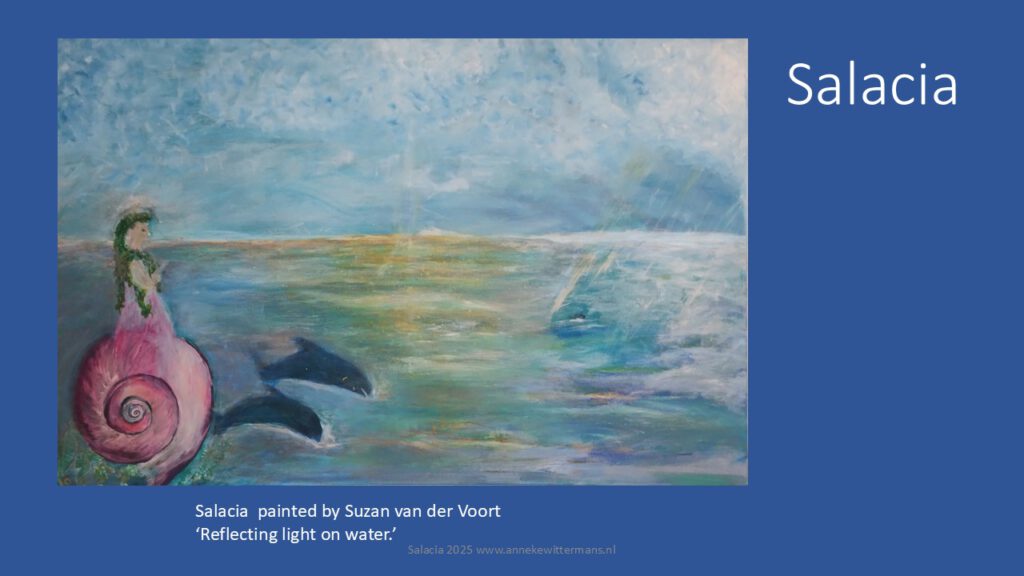
Salacia, schitteringen op het water
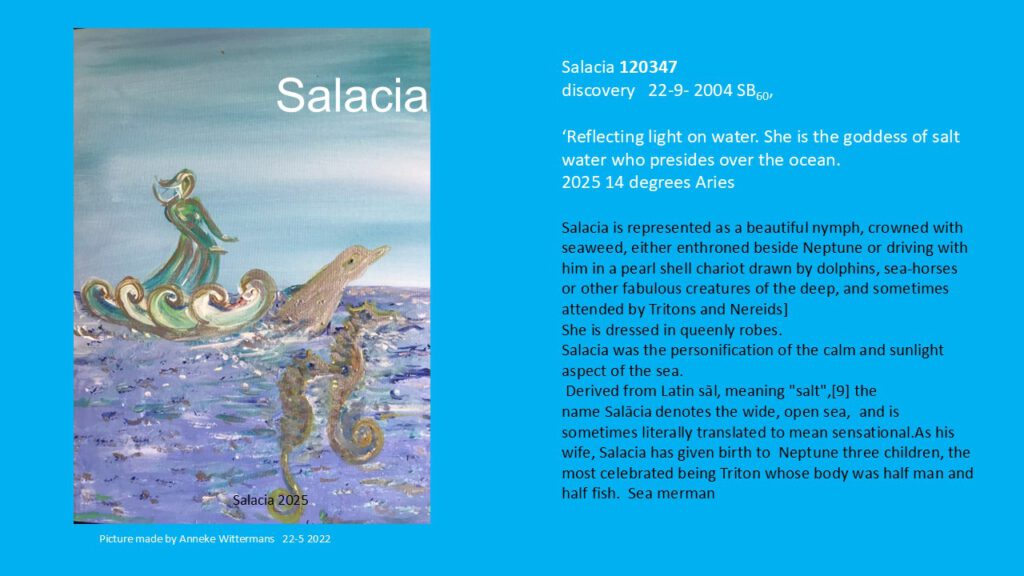
Salacia 120347
discovery 22-9- 2004 SB60,
‘Reflecting light on water. She is the goddess of salt water who presides over the ocean.
2025 14 degrees Aries
The Role of Salacia in Mythology
Before being the consort of Neptune and the queen of the ocean, Salacia was only a sea nymph. Her name derives from the Latin Sal, which means salt. As a goddess of the sea, she represented the calm, open, and vast sea as well as the sunlit sea. Salacia was also the goddess of saltwater, so her domain extended as far as the ocean did. In some accounts, she was the goddess of the springs and their mineralized water.
Salacia and Neptune had three sons who were popular figures of the seas. The most famous was their son Triton, a god of the sea. Triton had body that was half-fish half-man, and in later times, Triton became symbolic of mermen.
In Brief
The sea was an important feature in the lives of the Romans, especially in light of their constant voyaging and exploration. In this sense, the deities of the sea remained significant throughout the history of the Roman empire, and Salacia was no exception. Although not as famous as some other Roman deities, Salacia was venerated in her time for her role as a sea goddess.
Salacia is represented as a beautiful nymph, crowned with seaweed, either enthroned beside Neptune or driving with him in a pearl shell chariot drawn by dolphins, sea-horses or other fabulous creatures of the deep, and sometimes attended by Tritons and Nereids]
She is dressed in queenly robes.
Salacia was the personification of the calm and sunlight aspect of the sea.
Derived from Latin sāl, meaning “salt”,[9] the name Salācia denotes the wide, open sea, and is sometimes literally translated to mean sensational. As his wife, Salacia has given birth to Neptune three children, the most celebrated being Triton whose body was half man and half fish. Sea merman